Setting up a CI/CD pipeline to deploy App Builder apps using GitHub Actions
To deploy App Builder apps, App Builder supports a CI/CD pipeline using GitHub Actions out of the box. The following guide explains how you can set it up.
- Step 1: Add GitHub workflow files to your project directory
- Step 2: Prepare Stage Workspace for deployment using a CI/CD pipeline
- Step 3: Compute the
.aioand.envfiles - Step 4: Add secrets to your GitHub repository
- Step 5: Add any custom secrets
- Step 6: Repeat for Production workspace
- Step 7: Repeat for any other shared workspace
Step 1: Add GitHub workflow files to your project directory
GitHub Actions looks for the .github/workflows folder at the root of your App Builder app. You can define any number of workflows or CI/CD pipelines in that folder. Check out the documentation for GitHub workflows here.
App Builder supplies a few workflow definitions out of the box that rely on Adobe custom action - aio-app-action. If you started your App Builder app using aio app init, the workflow YAML files will be present in the .github/workflows folder at the root of your App Builder app.
However, if they're not already present, you can add them by running
# Add the Workflow definition files
aio app add ci

# Commit the workflow files to your repository's main branch
git add ./github/workflows/
git commit -m "Adding GitHub workflows"
git push
The following workflow definitions are supported out of the box:
- deploy_prod.yml: Deploys your application to the Production Workspace when you create a new release in your GitHub repository.
- deploy_stage.yml: Deploys your application to the Stage Workspace when you merge any code in the
mainbranch. - pr_test.yml: Unit tests your code in a pull request when the pull request is created. To run unit tests against the pull request, the workflow runs
aio app test.
Step 2: Prepare Stage Workspace for deployment using a CI/CD pipeline
To enable a workspace for deployment via a CI/CD pipeline:
- Open the Developer Console
- Navigate to your App Builder Project and Stage Workspace
- Add the I/O Management API to the workspace. This will add an OAuth Server-to-Server credential to the workspace, if one is not already present. It will also ensure that the credential has the right scopes to deploy your application.
- Click the Download all button on the Workspace overview page to download the workspace.json file.
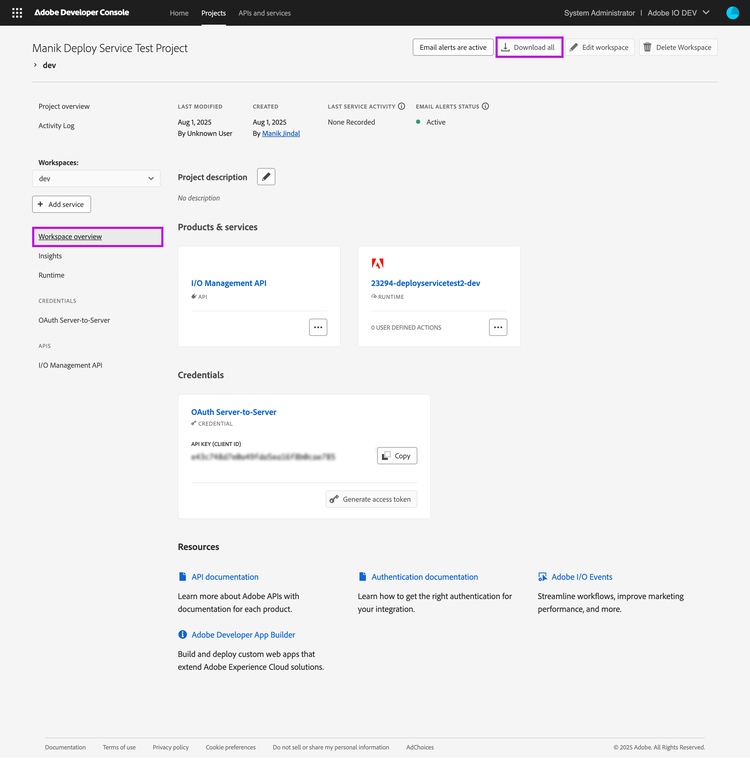
Step 3: Compute the .aio and .env files
data-slots=text
app.config.yaml, .aio, and .env files.- Open your terminal and navigate to the root of your App Builder app.
- Run
aio app use path/to/workspace/json/from/step1_4.json> - When prompted, be sure to merge the
.aioand the.envfiles to avoid losing any other configuration you may have added to those files.
Step 4: Add secrets to your GitHub repository
Before you can deploy your app from the CI/CD pipeline using GitHub Actions, you must add your application secrets to your repository. App Builder uses GitHub Actions environments to scope secrets per deployment target. To set up the stage environment:
- Open your GitHub repository
- Navigate to the
Settingstab >Environmentson the left nav - Click
New environment, name itstage, and clickConfigure environment - Under
Environment secrets, clickAdd secret - Enter the secrets as key-value pairs in the Name and Secret text inputs respectively
- Click
Add secret
You must add the following secrets to the stage environment to ensure your CI/CD pipeline can test Pull Requests and deploy your application.
To obtain the values for each of these secrets in the correct format, use the following script to print your secrets to your terminal window.
Note: the script relies on the .aio and .env files to contain the correct values. Ensure you have completed the previous steps to compute the correct secret values.
#!/bin/bash

main (){

    config=$(aio config ls --json)

    # Extract workspace_services
    workspace_services=$(echo "$config" | jq -c '.project.workspace.details.services')

    # Check if I/O Management API is present
    if ! echo "$workspace_services" | jq -e 'any(.[]; .code == "AdobeIOManagementAPISDK")' > /dev/null; then
    echo "Error: I/O Management API was not found in your workspace." >&2
    exit 1
    fi

    # Get the lowercase context name
    ctx=$(echo "$config" \
        | jq -r '.project.workspace.details.credentials[] | select(.integration_type == "oauth_server_to_server") | .name' \
        | tr '[:upper:]' '[:lower:]'
    )

    echo "CLIENTID:                     $(echo "$config" | jq -r --arg ctx "$ctx" '.ims.contexts[$ctx].client_id')"
    echo "CLIENTSECRET:                 $(echo "$config" | jq --arg ctx "$ctx" '.ims.contexts[$ctx].client_secrets' |  jq -r | jq -r '.[0]')"
    echo "TECHNICALACCID:               $(echo "$config" | jq -r --arg ctx "$ctx" '.ims.contexts[$ctx].technical_account_id')"
    echo "TECHNICALACCEMAIL:            $(echo "$config" | jq -r --arg ctx "$ctx" '.ims.contexts[$ctx].technical_account_email')"
    echo "IMSORGID:                     $(echo "$config" | jq -r --arg ctx "$ctx" '.ims.contexts[$ctx].ims_org_id')"
    echo "SCOPES:                       $(echo "$config" | jq --arg ctx "$ctx" '.ims.contexts[$ctx].scopes' | jq -r | jq -r '. | join(",")')"
    echo "AIO_RUNTIME_NAMESPACE:        $(echo "$config" | jq -r '.runtime.namespace')"
    echo "AIO_RUNTIME_AUTH:             $(echo "$config" | jq -r '.runtime.auth')"
    echo "AIO_PROJECT_ID:               $(echo "$config" | jq -r '.project.id')"
    echo "AIO_PROJECT_NAME:             $(echo "$config" | jq -r '.project.name')"
    echo "AIO_PROJECT_ORG_ID:           $(echo "$config" | jq -r '.project.org.id')"
    echo "AIO_PROJECT_WORKSPACE_ID:     $(echo "$config" | jq -r '.project.workspace.id')"
    echo "AIO_PROJECT_WORKSPACE_NAME:   $(echo "$config" | jq -r '.project.workspace.name')"
    echo "AIO_PROJECT_WORKSPACE_DETAILS_SERVICES:   $(echo "$config" | jq -r -c '.project.workspace.details.services')"
}

main
To run this script:
- Save the above script on your machine as
fetch-secrets.sh - Run
chmod +x path/to/fetch-secrets.sh - Navigate to the root of your App Builder app
- Run
path/to/fetch-secrets.sh
Here's a sample output
➜  app-builder pbpaste > fetch-secrets.sh
➜  app-builder chmod +x fetch-secrets.sh
➜  app-builder cd test-deploy-service
➜  test-deploy-service ../fetch-secrets.sh
CLIENTID:                     dc***************************64c
CLIENTSECRET:                 p**-******************************Nl
TECHNICALACCID:               0*********************AC@techacct.adobe.com
TECHNICALACCEMAIL:            2******d-4**c-4**2-8**f-1*********a4@techacct.adobe.com
IMSORGID:                     6*********************01@AdobeOrg
SCOPES:                       ["AdobeID","openid","read_organizations","additional_info.projectedProductContext","additional_info.roles","adobeio_api","read_client_secret","manage_client_secrets"]
AIO_RUNTIME_NAMESPACE:        2***4-manikdeploytest-stage
AIO_RUNTIME_AUTH:             2******a-d**2-4**1-9**c-9*********9:C46C4C8038Vs5hrS2i0tqNw0a80unnv1jdtLW6K7weku4UA7jSjQ805YB0WIxlSC
AIO_PROJECT_ID:               45***************13
AIO_PROJECT_NAME:             ManikDeployTest
AIO_PROJECT_ORG_ID:           23294
AIO_PROJECT_WORKSPACE_ID:     45***************57
AIO_PROJECT_WORKSPACE_NAME:   Stage
AIO_PROJECT_WORKSPACE_DETAILS_SERVICES:   [{"code":"AdobeIOManagementAPISDK","name":"I/O Management API"}]
data-slots=text
stage environment. No suffix is needed — environment scoping ensures the correct secrets are used for each deployment target.Step 5: Add any custom secrets
If your App Builder app requires other application secrets (such as API keys for third-party APIs), you will also need to store them in the stage GitHub Actions environment. To do so
-
Add your secrets to
deploy_stage.ymlfile. Add them under theenvkey under theDeploystep.MY_CUSTOM_SECRET: ${{ secrets.MY_CUSTOM_SECRET }}Adding the secret to the workflow definition is equivalent to adding the secret to the
.envfile locally. The CI/CD pipeline will ensure your action receives this secret during deployment. -
Save the value of
MY_CUSTOM_SECRETto thestageenvironment in your GitHub repository (steps are outlined in Step 4).
Step 6: Repeat for Production workspace
Repeat steps 2-5 for the Production workspace. We have included some notes for each step below.
- Step 2: Add I/O Management API to the Production workspace
- Step 3: Compute the
.aioand.envfiles for your Production workspace - Step 4: Once you've computed the
.aioand.envfile, you can run thefetch-secrets.shscript again to see the production values. In your GitHub repository, go toSettings>Environments, create a new environment namedproduction, and add the secrets listed in the table below. Use the same secret names as in thestageenvironment — environment scoping keeps the values separate. - Step 5: Ensure that you pick the production values of your custom secrets and add them to the
productionenvironment and to thedeploy_prod.ymlfile instead.
Step 7: Repeat for any other shared workspace
You can set up CI/CD to deploy to any workspace. To do so:
- Create another GitHub workflow
deploy_workspace.ymlin the.github/workflowsfolder. - You can freely customize the trigger for the workflow and other aspects of deployment. Read the documentation for GitHub workflows here. Also see the GitHub actions published by App Builder.
- Similar to how you performed steps 2-6 for the Production workspace, you can repeat them for another workspace. In the new workflow file, set the
environmentfield on the job to the name of the GitHub Actions environment you created for that workspace. Add the required secrets to that environment in your GitHub repository — no suffix is needed as the environment provides the scoping.