JavaScript Logger
The Logger class provides logging functionality for an application. It can be used to display errors, warnings and debug messages.
Constructor: <Magento_Ui_module_dir>/view/base/web/js/lib/logger/logger.js. (See on GitHub)
Logger API
new Logger(outputHandler, entryFactory)
Parameters:
outputHandler: LogOutputHandler: An instance ofLogOutputHandlerused to display log entries.entryFactory: LogEntryFactory: A factory of theLogEntryinstances.
setDisplayLevel(level)
Sets the boundary entry level. The entries whose level is lower, than the specified one, are not passed to the output.
Parameters: level: number: Minimum display level for an entry.
addDisplayCriteria(criteria)
Adds a function that is used to define whether newly created entries should be passed to the output.
Parameters: criteria: Function: A function that accepts instance of the LogEntry and returns a Boolean value.
removeDisplayCriteria(criteria)
Removes the previously added display criteria.
Parameters: criteria: Function: The display criteria to be removed.
error(message, [messageData])
Creates a LogEntry with the ERROR level and passes it to the output, if it matches all current display criteria.
Parameters: message: string: Entry's message.
messageData?: Object: Optional data associated with the message.
Returns: LogEntry
warn(message, [messageData])
Creates a LogEntry with the WARN level and passes it to the output, if it matches all current display criteria.
Parameters: message: string: Entry's message.
messageData?: Object: Optional data associated with the message.
Returns: LogEntry
info(message, [messageData])
Creates a LogEntry with the INFO level and passes it to the output if it matches all current display criteria.
Parameters: message: string: Entry's message.
messageData?: Object: Optional data associated with the message.
Returns: LogEntry
debug(message, [messageData])
Creates a LogEntry with the DEBUG level and passes it to the output, if it matches all current display criteria.
Parameters: message: string: Entry's message.
messageData?: Object: Optional data associated with the message.
Returns: LogEntry
getEntries([criteria])
Returns all available log entries. It can additionally filter out the entries that don't match the provided criteria.
Parameters: criteria?: Function: Optional function that accepts an instance of LogEntry and implements the filter criteria by which the entries are added to the resulting array.
Returns: Array<LogEntry>: An array of LogEntry.
dump(criteria)
Parameters: criteria?: Function: Optional function that accepts an instance of LogEntry and implements the filter criteria by which entries are passed to the output handler.
LogEntry
LogEntry is a class that holds the data of log operations, like error, warn, info and so on.
Constructor: <Magento_Ui_module_dir>/view/base/web/js/lib/logger/entry.js. (See on GitHub)
new LogEntry(message, level, [data])
Parameters:
message: string: Entry's message.level: number: Entry's level.data?: Object: Additional data associated with the entry.
Properties:
-
message: string: Entry's message. -
timestamp: number: The time of entry creation. -
level: number: Entry's level. -
levelName: string: Name of the entry's level. -
data?: Object: Additional data associated with the entry.
LogOutputHandler
The LogOutputHandler class responsible for the output of entries passed by Logger. Default implementation uses browser's console object and invokes methods that correspond to the level of an entry. For instance, entry with the INFO level will be displayed using the console's info method.
Constructor: <Magento_Ui_module_dir>/view/base/web/js/lib/logger/console-output-handler.js (See on GitHub)
new LogOutputHandler(formatter)
Parameters: formatter: LogFormatter: An instance of LogFormatter that will be used to create a display message for the provided entries.
show(entry)
Displays the provided entry.
Parameters: entry: LogEntry: The entry to be displayed.
dump(entries)
Displays multiple entries at once.
Parameters: entries: Array<LogEntry>: An array of the LogEntry instances to be displayed.
LogFormatter
The LogFormatter class is responsible for processing the message of the provided entry and for preparing its string representation that will be displayed by LogOutputHandler. It also verifies if the entry's message is set in the template:
 {
     message: "Foo ${ $.property }",
     data: {
         property: "Bar"
    }
} // => "Foo Bar"
Constructor: <Magento_Ui_module_dir>/view/base/web/js/lib/logger/formatter.js (See on GitHub)
new LogFormatter([dateFormat], [template])
Parameters:
dateFormat = "YYYY-MM-DD hh:mm:ss": Date format that is applied to display the entry creation time.template = "[${ $.date }] [${ $.entry.levelName }] ${ $.message }: Template used to create the resulting message of an entry.
process(entry)
Creates a text representation of the provided entry. If default settings are used, the resulting string looks like following: [2017-04-07 01:36:24] [DEBUG] Log message.
Parameters: entry: LogEntry: An instance of LogEntry to be processed.
Returns: String
levelsPool
levelsPool is a module that provides log levels and utility methods to work with them.
The following log levels are available (sorted by priority in the descending order):
NONE(used to block all log entries from being passed to the output)ERRORWARNINFODEBUGALL(allows to display all log entries, unless any other display criteria is present)
Path: Magento_Ui_module_dir>/view/base/web/js/lib/logger/levels-pool.js (See on GitHub)
getLevels()
Returns a list of available log levels.
Returns: {[name: string]: number}
getNameByCode(code)
Parameters: code: string: Level's identifier.
Returns: Number
messagePool
Implements a collection of predefined messages used by consoleLogger.
Path: <Magento_Ui_module_dir>/view/base/web/js/lib/logger/message-pool.js (See on GitHub)
getMessage(code)
Returns message that matches the provided code.
Parameters: code: string: Message's identifier.
Returns: String
addMessage(code, message)
Adds a new message to the pool.
Parameters: code: string: Message's identifier.
message: string: Text of the message.
hasMessage(code)
Checks whether a message with the provided code exists in the pool.
Parameters: code: string: Message's identifier.
Returns: Boolean
consoleLogger
An instance of the Logger class that is configured to display messages in the browser's console with the default format. It also stores the last provided display level in localStorage and allows to work with a list of predefined messages instead of passing their text directly:
    consoleLogger.setDisplayLevel(consoleLogger.levels.ALL);
    consoleLogger.messages.addMessage('VIRAL_MESSAGE', 'Hello World!');
    consoleLogger.info('VIRAL_MESSAGE');
    // console => [2017-04-07 01:36:24] [INFO] Hello World!
Path: <Magento_Ui_module_dir>/view/base/web/js/lib/logger/console-logger.js (See on GitHub)
Properties
levels: {[name: string]: number}: Reference to the available log levels.messages: messagePool: Reference tomessagePoolthat allows working with a list of predefined messages.
Usages
By default, the application uses consoleLogger to display logs in browser console.
Example:
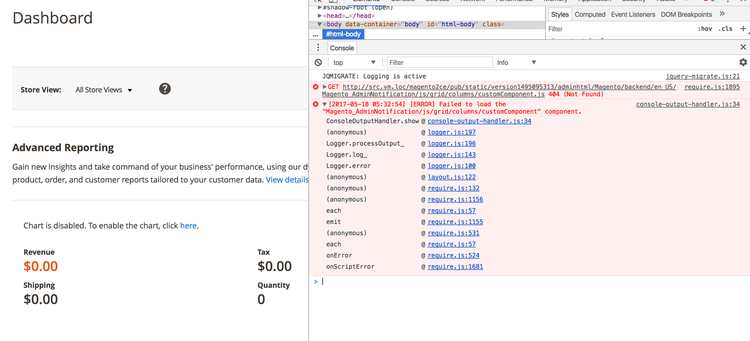
The default level of logs that display in the console starts from the WARN level.
Types of logged information
-
Templates loading:- Logging when a template's loading starts.
- Logging when a template is loaded. (from cache or from server)
- Logging error if a template's loading failed.
-
UI Components loading:- Logging when a component's loading starts.
- Logging when a component is loaded.
- Logging error if a component loading failed.
-
Requests for UI Components dependencies:- Logging when a component sends request for dependencies.
- Logging when a component's dependencies are successfully received.
- Logging when a component's receiving is failed.
-
Requests for UI Components by scope binding:- Logging when a component sends request for dependencies.
- Logging when dependencies are successfully received.
- Logging when dependencies receiving failed.