Commerce module development
This topic describes how to enable your custom modules for Adobe I/O Events. You can also manually register observer events using the events:subscribe command.
Find supported events
Adobe Commerce is capable of emitting thousands of different observer and plugin events, but most of them aren't good candidates for integrating with an external App Builder application. For example, Commerce emits events before and after a customer address is loaded, saved, or deleted, but the only events of consequence are those that indicate a change of status after the address is saved or deleted.
You can use the Commerce Admin or the command line to find supported events and their payloads:
-
In the Admin, select System > Events > Events List to display the Events list page.
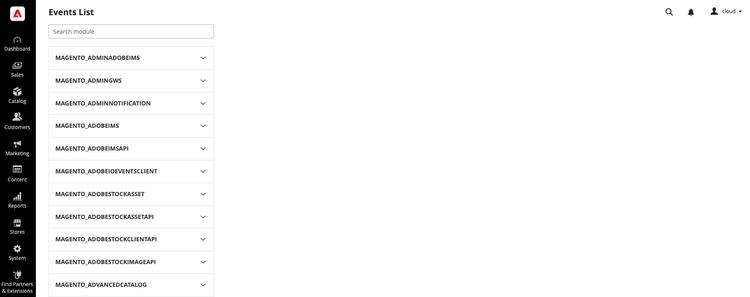
The left navigation contains a list of enabled modules on your system. Click on a module name to display a list of supported events. When you select an event, the main panel of the Admin displays the event's payload.
-
The
bin/magento events:list:allcommand returns all the detectable supported events in the specified module. Once you know the name of the event, you can use theevents:infocommand to return its payload.
Register events
You can programmatically register events using the following methods:
- Create an
io_events.xmlfile in your module or in the rootapp/etcdirectory - Declare them in the system
env.phporconfig.phpfile
data-src=/_includes/sample-event.md
After you've registered at least one event, run the eventsmodule command to generate the required plugins.
io_events.xml
Create the <module-root>/etc/io_events.xml or app/etc/io_events.xml file and define a list of events that should always be transmitted. Events listed in this file cannot be disabled with the events:unsubscribe command.
You can transmit all the fields within an event by setting the value of the field element to * (<field name="*" />). You cannot use the * wildcard character to match partial strings.
data-src=/_includes/event-size-limitation.md
Add custom fields to an event describes how to enhance the payload of pre-defined events.
<config xmlns:xsi="http://www.w3.org/2001/XMLSchema-instance" xsi:noNamespaceSchemaLocation="urn:magento:module-commerce-events-client/etc/io_events.xsd">
    <event name="observer.catalog_product_save_after">
        <fields>
            <field name="entity_id" />
            <field name="sku" />
            <field name="is_new" />
        </fields>
    </event>
    <event name="plugin.magento.sales.api.invoice_item_repository.save">
        <fields>
            <field name="entity_id" />
            <field name="parent_id" />
            <field name="base_price" />
            <field name="tax_amount" />
            <field name="base_row_total" />
            <field name="discount_amount" />
            <field name="qty" />
        </fields>
    </event>
    <event name="plugin.magento.catalog.model.resource_model.product.save">
        <fields>
            <field name="entity_id" />
            <field name="sku" />
            <field name="name" />
            <field name="price" />
            <field name="created_at" />
        </fields>
    </event>
</config>
The contents of an observer.catalog_product_save_after event are similar to the following:
{
    "value": {
    "entity_id": "3",
    "sku": "test2",
    "is_new": "0"
  }
}
The <field> element can also contain the converter attribute. Use this attribute to change the value of a field in the event payload. Convert payload field values describes its usage.
Array of nested objects
data-src=/_includes/nested-event.md
<config xmlns:xsi="http://www.w3.org/2001/XMLSchema-instance" xsi:noNamespaceSchemaLocation="urn:magento:module-commerce-events-client/etc/io_events.xsd">
   <event name="observer.sales_order_invoice_save_after">
      <fields>
         <field name="order_id" />
         <field name="items[].sku" />
         <field name="items[].qty" />
      </fields>
   </event>
</config>
The contents of the event are similar to the following:
{
   "order_id": "8",
   "items": [
      {
         "sku": "simple-product-2",
         "qty": "3.000000"
      },
      {
         "sku": "simple-product-1",
         "qty": "5.000000"
      }
   ]
}
config.php and env.php
You can also create an io_events section in the Commerce app/etc/config.php file. As of version of 1.11.0 of Adobe I/O Events for Adobe Commerce, you can also create an io_events section in the Commerce app/etc/env.php file. Events registered using this mechanism can be disabled from the command line.
For example:
'io_events' => [
    'observer.catalog_product_save_after' => [
        'fields' => [
            'entity_id',
            'sku',
            'is_new',
        ],
        'enabled' => 1
    ],
    'plugin.magento.sales.api.invoice_item_repository.save' => [
        'fields' => [
            'entity_id',
            'parent_id',
            'base_price',
            'tax_amount',
            'base_row_total',
            'discount_amount',
            'qty',
        ],
        'enabled' => 1
    ],
    'plugin.magento.catalog.model.resource_model.product.save' => [
        'fields' => [
            'sku',
            'entity_id',
            'name',
            'price'
        ],
        'enabled' => 1
    ],
]
The payload for the observer.catalog_product_save_after event is the same as shown in io_events.xml.
Configuration merging from different modules
If multiple Commerce modules register the same event, the configuration manager merges the two configurations. The transmitted event includes all the fields defined in the modules.
In the following example, the MODULE1/etc/io_events.xml file registers the observer.catalog_product_save_after event with the entity_id and sku fields.
<config xmlns:xsi="http://www.w3.org/2001/XMLSchema-instance" xsi:noNamespaceSchemaLocation="urn:magento:module-commerce-events-client/etc/io_events.xsd">
    <event name="observer.catalog_product_save_after">
        <fields>
            <field name="entity_id" />
            <field name="sku" />
        </fields>
    </event>
</config>
The MODULE2/etc/io_events.xml file registers the same event with the entity_id field and two others.
<config xmlns:xsi="http://www.w3.org/2001/XMLSchema-instance" xsi:noNamespaceSchemaLocation="urn:magento:module-commerce-events-client/etc/io_events.xsd">
    <event name="observer.catalog_product_save_after">
        <fields>
            <field name="entity_id" />
            <field name="quantity_and_stock_status.qty" />
            <field name="stock_data.min_qty" />
        </fields>
    </event>
</config>
The resulting configuration:
<config xmlns:xsi="http://www.w3.org/2001/XMLSchema-instance" xsi:noNamespaceSchemaLocation="urn:magento:module-commerce-events-client/etc/io_events.xsd">
    <event name="observer.catalog_product_save_after">
        <fields>
            <field name="entity_id" />
            <field name="sku" />
            <field name="quantity_and_stock_status.qty" />
            <field name="stock_data.min_qty" />
        </fields>
    </event>
</config>